What Is a Bill of Sale and When You Need One? A Complete Guide
Last Updated: March 25, 2026
TL;DR
A Bill of Sale is a legal document used in Canada to record the transfer of ownership of personal property from a seller to a buyer.
It serves as a formal receipt and proof of purchase, which is essential for registering vehicles, boats, and aircraft in most provinces.
The document provides legal protection by clearly outlining the purchase price, condition of the item, and the identities of the parties involved.
Provincial laws, such as the Sale of Goods Act, often imply certain warranties that can only be waived through clear as-is clauses in the Bill of Sale.
While it proves a transaction occurred, it does not guarantee the absence of liens, making a separate Personal Property Security Act search necessary
Navigating the landscape of private sales in Canada requires a firm grasp of the documentation needed to protect both the buyer and the seller. Whether an individual is selling a used car in Ontario, a fishing boat in British Columbia, or high value electronics in Alberta, the Bill of Sale stands as the cornerstone of the transaction. This document is far more than a simple receipt; it is a critical instrument that formalizes the transfer of title and establishes the legal rights of the parties under provincial jurisdiction.
In Canada, the rules governing these documents are primarily provincial, though federal regulations may touch upon specific assets like aircraft or maritime vessels. Failing to execute a proper Bill of Sale can lead to significant hurdles, ranging from an inability to register a vehicle to becoming embroiled in costly legal disputes over the condition of the property. This guide explores the depths of Canadian Bill of Sale laws to ensure every transaction is secure and legally sound.
Understanding the nuances of these laws is essential because each province maintains its own Sale of Goods Act, which sets the default rules for how ownership moves from one person to another. These acts provide a safety net for consumers but also allow for the modification of terms through written agreements. By documenting the specifics of a deal, Canadians can navigate the complexities of the second hand market with confidence and clarity.
The transition of personal property in a private context lacks the built in protections of a retail environment, making the Bill of Sale the primary shield against fraud and misrepresentation. It bridges the gap between a handshake agreement and a registered ownership status, serving as the official record that authorities require for tax assessment and public safety records. As we delve into the details, the importance of precision in every clause will become increasingly evident.
What Is a Bill of Sale?
A Bill of Sale is defined as a written instrument that transfers title or purports to transfer title to personal property from a seller to a buyer. In the Canadian legal context, it serves as the primary evidence that a contract of sale has been executed and that the property in the goods has passed to the new owner. This document is specifically used for moveable and tangible personal property, often referred to in legal circles as chattels.
Proof of ownership transfer
The most fundamental role of a Bill of Sale is providing proof of ownership transfer. When a buyer acquires a vehicle or a piece of machinery, the Bill of Sale acts as the definitive record that the seller has relinquished their rights and the buyer has attained them. This is particularly vital in Canada because many forms of personal property do not have a centralized title registry like land does.
In provinces like Alberta and Ontario, a Bill of Sale is a mandatory requirement to register a vehicle under a new owner's name. Without this proof, a buyer cannot obtain license plates or insurance for their newly purchased car, as the registry cannot verify that the transaction was legitimate. The document creates a clear chain of title that protects the buyer's investment and the seller's liability after the sale is complete.
The transfer of ownership is not just about physical possession but about the legal right to the asset. Under the Sale of Goods Act, the property in the goods passes to the buyer at the time the parties intend it to pass, which is usually when the Bill of Sale is signed and payment is made. This specific moment is recorded in the document, ensuring there is no ambiguity about who was responsible for the item at any given time.
Description of the item and deal
A Bill of Sale must contain a detailed description of the item and the deal to be effective. This means going beyond simple labels and providing unique identifiers that distinguish the specific item from all others. For a motor vehicle, this description includes the make, model, year, and the unique vehicle identification number.
The description of the deal encompasses the financial terms, including the total purchase price and the method of payment used. This clarity is essential for tax purposes, as provincial governments use the stated price to calculate the appropriate sales tax due upon registration. By documenting these details, the Bill of Sale ensures that both parties have a shared understanding of what is being exchanged and for what value.
Item Category
Essential Identification Details
Motor Vehicle
VIN, Make, Model, Year, Odometer
Pleasure Craft
Hull Serial Number, Make, Model, Length
Electronics
Serial Number, Model Number, Brand
Livestock
Breed, Sex, Age, Color, Brands
Signed by the parties
The signatures of the parties involved are what transform a list of terms into a legally binding Bill of Sale. In most Canadian jurisdictions, both the buyer and the seller must sign and date the document to acknowledge their agreement to the terms. These signatures represent mutual assent and the finalization of the contract.
While some simple transactions might only technically require the seller's signature to prove they have transferred the item, having both parties sign is standard practice to prevent future disputes. In some provinces, witnesses may also be required, or at least highly recommended, to add an extra layer of authenticity to the document. This ensures that if the validity of the sale is ever questioned in a court of law, there is a third party who can verify that the signatures were provided voluntarily.
Legally binding contract
A Bill of Sale is much more than a receipt; it is a legally binding contract that creates enforceable rights and obligations under Canadian law. Once signed, it serves as a record of the agreement that can be used as evidence in legal proceedings if one party fails to uphold their end of the deal. This contract covers the essential elements of an offer, acceptance, and consideration, which is the purchase price.
Because it is a contract, the Bill of Sale is subject to provincial legislation such as the Sale of Goods Act, which implies certain terms into the agreement even if they are not explicitly written. For example, the seller is implied to have the right to sell the goods and that the goods are free from undisclosed liens. The Bill of Sale is the primary document used to either confirm or waive these implied terms, making it a powerful tool for managing legal risk.
Why and When Do You Need a Bill of Sale?
The necessity of a Bill of Sale arises in almost every private transaction involving high value or regulated goods in Canada. While you might not need one for a five dollar used book, any item that requires registration or represents a significant financial investment should be accompanied by this formal documentation. It serves as a safeguard for the future, providing a paper trail that can resolve issues long after the transaction is finalized.
Proof of Ownership and Transfer
The most common reason a Canadian needs a Bill of Sale is to provide proof of ownership and transfer. When you purchase a used car from a private individual, the government does not automatically know that the ownership has changed hands. The Bill of Sale is the proof you present to provincial authorities to update the official records and claim legal title to the property.
This proof is equally important for the seller. By keeping a copy of the signed Bill of Sale, the seller can prove that they are no longer responsible for the item. If a vehicle is involved in an accident or receives a parking ticket after the sale but before the buyer has registered it, the seller can use the Bill of Sale to show that the property was transferred on a specific date and time.
Legal Protection and Clarity
A Bill of Sale offers legal protection and clarity that oral agreements simply cannot provide. In the event of a disagreement about the price paid or the condition of the item at the time of sale, the written document serves as the final authority. It reduces the risk of misinterpretation and provides a clear set of facts that both parties have agreed upon in writing.
For high value items, the clarity provided by a Bill of Sale can prevent complex legal battles. If a buyer claims the seller promised a warranty that was never intended, the Bill of Sale will be the primary piece of evidence used by a court to determine the actual terms of the deal. It establishes the ground rules of the transaction, ensuring that neither party can easily change their story later.
Requirement for Registration or Official Processes
Many Canadian institutions require a Bill of Sale for official processes and registrations. Provincial ministries of transportation across the country, such as ServiceOntario or Alberta Registries, mandate a Bill of Sale for the transfer of motor vehicle ownership. Similarly, Transport Canada requires a Bill of Sale to register or license a pleasure craft or an aircraft.
Beyond government agencies, insurance companies often request a Bill of Sale to establish the value of the item they are covering. Without this document, an insurer may struggle to determine the appropriate coverage or may refuse to issue a policy altogether. Banks and financial institutions also require these documents if the item is being used as collateral for a loan or if the purchase is being financed.
Taxes and Financial Records
Taxes represent a significant portion of the cost of acquiring goods in Canada, and the Bill of Sale is the document used to determine how much is owed. In most provinces, when you register a used vehicle purchased privately, you must pay provincial sales tax based on the purchase price listed on the Bill of Sale. Accurate records are essential for both the individual buyer and any business that needs to document asset acquisitions for accounting purposes.
In some jurisdictions, if the purchase price is significantly lower than the fair market value, the government may choose to tax the item based on its assessed wholesale value rather than the price on the Bill of Sale. This is done to prevent people from under reporting the price to avoid paying their fair share of taxes. Having a well documented Bill of Sale with clear explanations for a lower price, such as specific damage, can help in these situations.
Buying or Selling “As-Is”
The as-is clause is one of the most important components of a Bill of Sale for used goods in Canada. Selling an item as-is means the buyer accepts it in its current condition and the seller makes no promises regarding its future performance or hidden defects. This clause is vital for protecting sellers from being held liable for repairs that may become necessary shortly after the sale.
However, the as-is clause must be handled with care. Under the Sale of Goods Act, certain warranties are implied by law unless they are explicitly and clearly waived in the contract. For example, the item must be reasonably fit for the purpose for which it was sold. A Bill of Sale that includes a robust as-is statement helps ensure that the buyer understands the risks they are taking and that the seller is protected from future claims.
High-Value and Unique Items
For high value and unique items, a Bill of Sale is even more critical due to specialized taxes and regulations. The Canadian federal government has recently introduced a luxury tax on certain vehicles and aircraft priced above 100,000 dollars and certain vessels priced above 250,000 dollars. The Bill of Sale is the primary document used to determine if this tax applies and how much is due to the Canada Revenue Agency.
For unique items like art, antiques, or specialized machinery, the Bill of Sale provides the only reliable record of the item's provenance and value. These documents are essential for estate planning, insurance appraisals, and future resales. In a market where authenticity is everything, a well drafted Bill of Sale that includes a detailed history and description can significantly enhance the value and security of the asset.
What Should Be Included in a Bill of Sale
Title the Document and Identify the Parties
Every professional Bill of Sale should begin with a clear title that identifies the nature of the document. Following this, the document must accurately identify the parties involved by providing their full legal names and current physical addresses. This ensures there is no confusion about who is selling the property and who is acquiring it, which is the first step in establishing a valid contract.
In Canada, it is highly recommended to verify the identities of the parties using government issued photo identification. For the buyer, this confirms that the person selling the item is indeed the person listed on the registration documents. For the seller, it ensures they have a reliable way to contact the buyer if any issues arise with the payment or the transfer of title after the sale.
Describe the Item Being Sold
The description of the item is the heart of the Bill of Sale and must be as specific as possible to prevent identification issues. For a motor vehicle, this section must include the year, make, model, body type, and color, but most importantly, it must include the unique vehicle identification number. This seventeen digit code is the only way to positively identify a specific vehicle from others of the same make and model.
For items other than vehicles, you should include any serial numbers, model numbers, or distinctive markings. If you are selling a boat, the hull serial number is the required identifier. For electronics or tools, the manufacturer serial number should be listed. The more detail provided in this section, the less likely there will be a dispute about exactly which item was intended to be sold.
State the Sale Price and Payment Terms
The sale price is a critical figure that must be clearly stated in the Bill of Sale. This amount should be written in both numbers and words to prevent any unauthorized alterations to the document. In addition to the total price, the Bill of Sale should specify the currency, which is typically Canadian dollars for domestic transactions.
The payment terms should also be detailed, noting whether the item was paid for in full or if there is a remaining balance. If the payment was made via a specific method like a bank draft, e-transfer, or cash, this should be noted as well. In cases where a trade-in is part of the transaction, the Bill of Sale must describe the trade-in item and its agreed value, as this can affect the final tax calculation in many provinces.
Include Condition and Warranties (or “As-Is” Clause)
Clearly stating the condition of the item is essential for managing the expectations of both parties. If the seller is offering any specific warranties, such as a promise that the engine was recently rebuilt, these must be included in writing to be enforceable. Conversely, if the item is being sold with no warranties at all, the Bill of Sale must include a prominent as-is clause.
In Canada, an effective as-is clause usually states that the buyer has inspected the item and accepts it in its current state without any guarantees of its quality or fitness for use. This is particularly important for vehicles that may not pass a safety inspection. In Ontario, for example, if a vehicle is sold as-is, the Bill of Sale must often include a specific statement that the vehicle may not be roadworthy and could require substantial repairs.
Add Any Additional Terms or Disclosures
The Bill of Sale is the place to add any additional terms that the parties have agreed upon. This might include a deadline for the buyer to remove the item from the seller's property or an agreement that the seller will provide certain maintenance records. These extra details help ensure that the entire agreement is captured in a single document.
Disclosures are also a vital part of this section. Sellers should disclose any known major issues, such as a history of being a salvage vehicle or having significant water damage. Providing these disclosures in writing can protect a seller from claims of fraud or misrepresentation later on. In some provinces, certain disclosures are legally required for vehicle sales to ensure that buyers are making an informed decision.
Specify the Date and Governing Jurisdiction of the Sale
The date of the sale is a vital piece of information that determines when the legal responsibility for the item shifts from the seller to the buyer. This date is used by provincial registries to determine if a buyer has met the required registration deadlines. It also serves as the reference point for any warranties or as-is conditions agreed upon at the time of the transaction.
Specifying the governing jurisdiction is also important, especially if the buyer and seller reside in different provinces. This clause states which provincial laws will be used to interpret the Bill of Sale if a dispute arises. Typically, the laws of the province where the sale takes place will apply, but explicitly stating this in the document provides additional legal certainty for both parties.
Signatures of Seller (and Buyer) and Notary/Witness (if required)
The final section of the Bill of Sale is for the signatures of the seller and the buyer. While many simple transactions only require the parties' signatures, some high value deals may benefit from the presence of witnesses. A witness is an independent person who watches the parties sign the document and then adds their own signature to confirm that the process was legitimate.
In certain specific cases, such as the sale of an aircraft or a maritime vessel, a notary public or a commissioner for oaths may be required to formally acknowledge the signatures. Even when not strictly required by law, having a Bill of Sale notarized can add a significant level of credibility to the document. It provides a higher level of assurance that the parties are who they say they are and that the agreement is authentic.
Bill of Sale Templates and Free Forms
Using a template is the most efficient way to ensure that your Bill of Sale meets all the necessary legal requirements in Canada. While it is possible to write your own document from scratch, missing a key piece of information like a VIN or a proper as-is clause can lead to significant problems down the line. A well designed template provides a structured format that prompts you to include all the essential details.
There are many sources for Bill of Sale templates, including provincial government websites that often provide basic forms for vehicle sales. However, these government forms are often very basic and may not allow for the customization needed in more complex transactions. Using a professionally drafted template from a legal forms provider can offer more flexibility and comprehensive protection for unique situations
Why Ziji Legal Forms Is a Smarter Choice
Ziji Legal Forms offers a sophisticated and user friendly alternative to generic templates and basic government forms. The platform is designed specifically to handle the nuances of Canadian law, ensuring that your Bill of Sale is compliant with provincial regulations. By using an interactive process, Ziji helps you create a customized document that fits the specific needs of your transaction.
One of the biggest advantages of Ziji is the level of detail it incorporates into the final document. Rather than a one size fits all approach, the platform asks specific questions about the item being sold, the payment terms, and any disclosures you wish to make. This ensures that your Bill of Sale is a robust legal instrument that provides maximum protection for your interests, whether you are buying or selling.
Ziji Legal Forms Walkthrough: Creating a Bill of Sale
Creating a professional Bill of Sale with Ziji Legal Forms is a straightforward process that guides you through every necessary step. The platform is designed to be intuitive, ensuring that even those without legal experience can produce a high quality document.
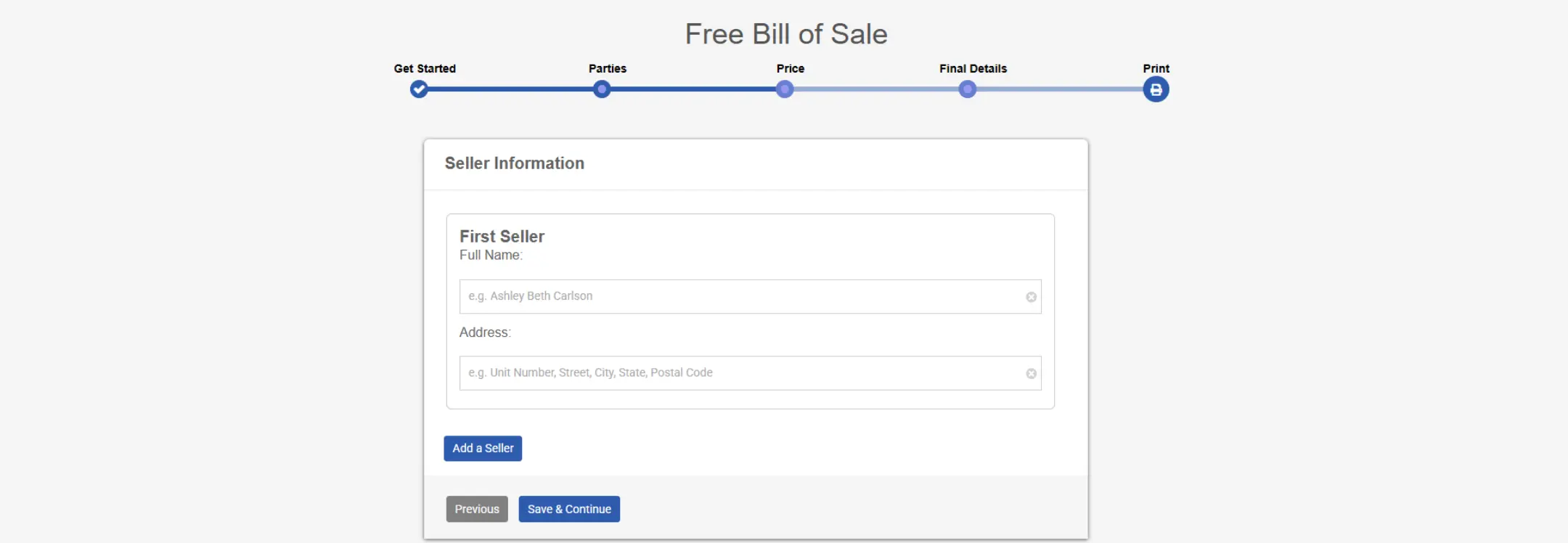
The next step requires you to add party details by providing the full legal names and addresses for both the buyer and the seller.
3. Add Pricing Details
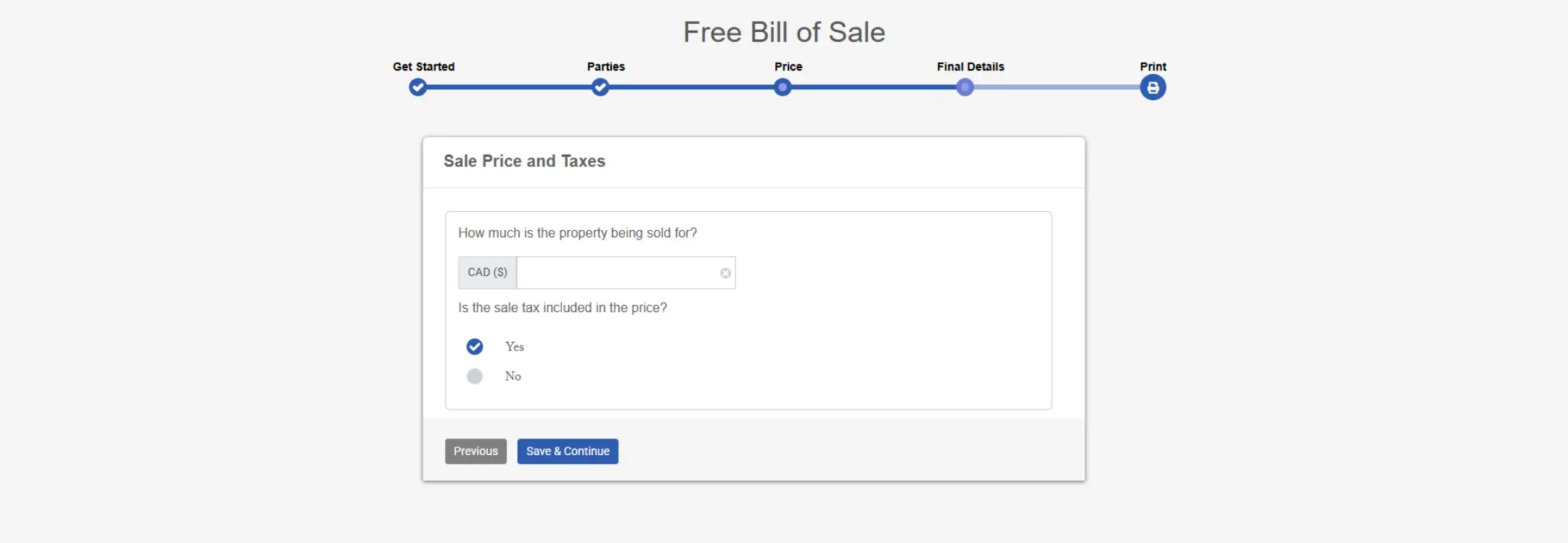
After identifying the participants you must add pricing details including the total sale price and the agreed upon method of payment.
4. Add Final Details
Next final details such as the specific item identification numbers and any relevant as-is condition clauses.
5. Preview and Print
The final step is to preview and print your completed Bill of Sale so that it can be reviewed and signed by both parties.
When Not to Use a Bill of Sale
While a Bill of Sale is a versatile tool, it is not the appropriate document for every type of property transfer in Canada. There are specific instances where different legal instruments and processes are required to ensure a valid transfer of ownership. Using the wrong document can lead to a transfer that is not recognized by the law or government authorities.
Not for Real Estate or Land Transfers
A Bill of Sale should never be used for the transfer of real estate, which includes land, houses, and permanent buildings. Real property transactions in Canada are governed by provincial land title or registry acts and require formal deeds or transfers that must be registered in the provincial land registry system. These processes involve specialized legal requirements that a standard Bill of Sale for personal property simply cannot satisfy.
Not a Substitute for Title Transfer
It is important to remember that a Bill of Sale is evidence of a transaction but is not always a substitute for the official title transfer with the government. For regulated items like motor vehicles, the Bill of Sale is the document you use to request a title transfer, but the transfer is not complete until the provincial registry issues a new vehicle permit in the buyer's name. Simply signing a Bill of Sale does not update the government's records; both parties must often take additional steps to finalize the process.
Intangible Property and Other Special Cases
Intangible property, such as intellectual property rights, trademarks, and patents, cannot be transferred using a standard Bill of Sale. These assets are governed by federal legislation like the Patent Act or the Trademarks Act and require specific assignment agreements that address nuances like moral rights and geographic limitations. Because these assets have no physical form, the rules for their transfer are significantly different from those governing tangible goods.
Verify Ownership and Liens Separately
A Bill of Sale does not automatically guarantee that the seller owns the item free and clear of all debts. In Canada, it is the responsibility of the buyer to verify that there are no registered liens against the property by performing a search of the provincial Personal Property Security Act registry. Even if a Bill of Sale states that the item is free from encumbrances, a registered lien holder may still have the right to repossess the item if the original debt is not paid.
Before finalizing any significant purchase, a buyer should always conduct their own due diligence. This includes checking the seller's identification against the current registration and performing a thorough lien search. The Bill of Sale is a powerful tool for recording the deal, but it is just one part of a comprehensive strategy for a safe and successful private sale in Canada.
Conclusion
A well researched Bill of Sale is the most effective way to ensure a smooth and legal transfer of personal property within Canada. By following provincial requirements and using professional tools, both buyers and sellers can navigate the second hand market with a high degree of confidence. This document serves as the essential link between a private agreement and the formal recognition of ownership by government authorities and insurance providers.
Bill of Sale FAQs
What else can a bill of sale be called?
A bill of sale can also be referred to as follows: sales receipt, or proof of purchase. It can also have a longer name that references the item being sold, for example: RV trailer bill of sale, or bill of sale for vehicle.
What’s a bill of sale?
A bill of sale is a document that details the sale and transfer of property from the seller to the buyer.
When can you use a bill of sale?
A bill of sale can be used for most private sale of physical goods. The most common situation where a bill of sale is used is for the sale of a used car. Note that the transfer of property cannot be done via a bill of sale.
Here is common list of goods that can be sold via our bill of sale:
Vehicles such as sedans, pick up trucks and motorcycles
Recreational vehicles such as RVs, trailers, dirt bikes, and snowmobiles
Watercrafts such as canoes, motorboats, jet skis and sail boats
Firearms such as pistols and hunting rifles
Animals such as pet cats, dogs, fish and birds, and farm animals such as hogs, horses and cattle.
Personal items such as clothing, jewellery and watches
Electronics such as audio receivers, HD televisions, computers, laptops, tablets and cell phones
What does being sold “as is” mean on a bill of sale?
An item that is sold “as is” means there is no guarantee as to the condition of the item. The buyer will be accepting the item in its current condition with any flaws present and the seller will be not responsible for any defects or flaws in the item.
What should be included in a bill of sale?
The bill of sale needs to have the following three main topics covered:
The buyers and sellers, list who the parties are and their respective addresses
The property listed in detail. Describe the item that is being sold to ensure that it’s identifiable. You want to be very specific in the detail to ensure there’s no ambiguity. If you’re selling a car, list the year, make, model, vehicle type and the VIN number including the odometer reading of the car. If you’re selling electronics, list the model and serial number of the item.
The price of the item. List the sale price for the item being sold and whether there are any taxes payable in the transaction. Also listing the forms of payment being used in the transaction
Who should sign a bill of sale?
It is good practice to get both the buyer and seller to sign the bill of sale especially for the sale of more expensive items like cars and boats. Having both signatures enhances the authenticity of the parties’ intention to transfer the ownership from the buyer to the seller in case there is future dispute.
Do I need to sign in front of a notary for the bill of sale?
Notarization is typically not required in most cases. However, it might be prudent to get the bill of sale notarized for more expensive goods such as cars and boats in case of future dispute. A notarized bill of sale solidifies the seller’s intention to transfer the goods to the buyer since the transaction was witnessed and recorded by the notary after having verified the identify of both parties.
Is a bill of sale applicable for both new and previously owned goods?
Absolutely. A bill of sale can be used to record the sale and ownership transfer for items whether they are brand new or used. It serves as official documentation of the transaction regardless of the condition.
What records should I retain after completing a bill of sale?
It’s important that both the buyer and seller keep a copy of the signed bill of sale. This documentation can be useful for tax filings, warranty claims, or settling any future disagreements about the sale.
How does a bill of sale differ from a simple receipt?
A bill of sale offers more detail than a typical receipt. Besides showing proof of payment, it confirms the transfer of ownership and outlines the terms of the sale, making it a stronger legal proof of the transaction.
Is it appropriate to use a bill of sale for online purchases?
Yes, a bill of sale can be very helpful for transactions conducted over the internet, especially for higher-value items. It provides both buyer and seller with a clear record of the sale and its conditions.
What if the buyer requests a warranty or assurance?
If any warranty or guarantee is provided, it should be clearly indicated in the bill of sale document. Otherwise, most private sales are considered “sold as is,” meaning the seller does not promise anything about the item’s condition or future reliability.
What jurisdictions can use our bill of sale?
You can use our template to create a legal and valid bill of sale for the following jurisdictions:





 Canada
 United States