TL;DR- A Last Will and Testament serves as the primary legal instrument for directing the distribution of an individual's assets and the guardianship of their children after death.
- Canadian law requires the testator to be of the age of majority and have the mental capacity to understand the nature of the document they are signing.
- Valid wills must generally be written and signed by the testator in the presence of two adult witnesses who are not beneficiaries of the estate.
- Dying without a will results in intestacy, where provincial statutes dictate asset distribution, often excluding common law partners and complicating the probate process.
- The executor plays a vital role in settling debts, filing final tax returns with the Canada Revenue Agency, and distributing the residue of the estate to beneficiaries.
- Canada utilizes a deemed disposition rule at death, which can trigger significant capital gains taxes that the estate must settle before final distribution.
- You can create a legally valid last will and testament with a Ziji Legal Form template
The Fundamental Nature of a Last Will and Testament
A Last Will and Testament represents the final expression of an individual's autonomy over their worldly possessions and personal responsibilities. In Canada, this document is a unique legal instrument that remains ambulatory, meaning it has no legal effect until the moment of the testator's death. This characteristic allows the creator to modify or revoke the document at any time as long as they retain the necessary mental capacity to do so. The primary objective of the document is to provide a clear and legally enforceable set of instructions for the administration of the estate.
The legal definition of a will in Canada extends beyond a simple list of beneficiaries. According to provincial statutes like the Wills Act, the term encompasses testaments, codicils, and appointments by will that exercise testamentary power. It serves as a comprehensive plan that addresses real property, personal belongings, and the management of liabilities. By centralizing these instructions, the testator provides a roadmap that helps survivors navigate the complexities of the legal and financial systems during a period of grief.
Furthermore, a Last Will and Testament Canada acts as a safeguard against the default rules of the state. Without this document, the legal system treats the individual as having died intestate, which triggers a pre-determined distribution scheme that may not reflect the person's actual wishes or the needs of their unique family structure. The document is therefore an essential tool for anyone who wishes to maintain control over their legacy and ensure that their loved ones are provided for according to their specific intentions.
Historical and Jurisdictional Context of Canadian Estate Law
Understanding the current landscape of Canadian estate law requires an appreciation of its jurisdictional foundations. Unlike many other areas of law that are federal in nature, the regulation of wills and estates falls primarily under the authority of individual provinces and territories. This means that while the core principles are consistent across the country, the specific formalities and procedural requirements can vary significantly depending on where the testator resides at the time of their passing.
Most Canadian provinces, excluding Quebec, follow a common law tradition heavily influenced by English legal history. This tradition emphasizes the freedom of the testator to dispose of their assets as they see fit, subject to certain moral and legal obligations to support dependents. Provinces like Ontario have codified these rules in the Succession Law Reform Act, while British Columbia uses the Wills, Estates and Succession Act to govern testamentary matters.
In Quebec, the legal system is based on the Civil Code, which introduces different concepts such as notarial wills that do not require probate in the same way as common law wills. For those living in the common law provinces, the process of validating a will often involves the court through probate, which provides a formal stamp of approval on the executor's authority. This jurisdictional complexity highlights the importance of using a Last Will and Testament template that is tailored to the specific laws of the relevant province.
Why You Need a Last Will and Testament Canada
The decision to create a will is often delayed by many Canadians, with estimates suggesting that more than half of the adult population lacks an up to date document. This procrastination often stems from the misconception that estate planning is only for the wealthy or the elderly. However, the benefits of a well drafted will are universal, providing protection for families of all sizes and financial backgrounds.
Control Over Asset Distribution
The most immediate benefit of a will is the ability to name exactly who should receive specific assets. In the absence of a will, provincial intestacy laws take over and divide the estate according to a rigid formula that often favors blood relatives over other intended beneficiaries. This can be particularly problematic for individuals who wish to leave gifts to friends, charities, or non-traditional family members who are not recognized as heirs under the law.
For those in common law relationships, the lack of a will can be catastrophic. In provinces like Ontario, common law spouses do not have the same automatic inheritance rights as married spouses. Without a valid will, a surviving common law partner may receive nothing from the estate and could even be forced to move out of the family home if they are not on the title. Creating a will is therefore the only reliable way to ensure that a common law partner is financially secure and protected.
Appointment of Guardianship for Minors
For parents, the guardianship clause is arguably the most critical component of a Last Will and Testament Canada. This section allows parents to nominate the person they believe is best suited to raise their children if both parents pass away. While the courts always retain the final say based on the best interests of the child, the choice expressed in a will is given significant weight and usually serves as the default appointment.
Failing to name a guardian can lead to prolonged and expensive court battles between family members who have different ideas about the child's upbringing. It can also result in children being placed in the care of individuals the parents would not have chosen. By naming a guardian and an alternate, parents provide their children with stability and ensure that their values and wishes regarding their upbringing are respected.
Minimizing Administrative Delays and Costs
A valid will simplifies the probate process by clearly naming an executor who has the authority to manage the estate. When a person dies intestate, the court must appoint an administrator, which requires a formal application and often a bond to guarantee the administrator's performance. This extra layer of court involvement adds time and expense to the process, delaying the distribution of assets to those who may need them for daily living expenses.
Furthermore, an executor named in a will can begin their duties almost immediately, such as making funeral arrangements and securing the deceased's property. The clarity provided by a will also reduces the likelihood of legal challenges and disputes among survivors. By investing in an Online Last Will and Testament now, individuals can save their families thousands of dollars in legal fees and months of administrative frustration later.
Key Components of a Canadian Last Will and Testament
A robust will is comprised of several essential sections that address the different aspects of an individual's life and legacy. Each component must be clearly drafted to avoid ambiguity and ensure that the document can be executed according to the testator's wishes.
The Appointment of the Executor
The executor is the central figure in the administration of the estate. This person is responsible for locating the will, valuing the assets, paying off all debts and taxes, and finally distributing the residue to the beneficiaries. Choosing an executor requires careful consideration of the individual's reliability, financial literacy, and willingness to take on a role that can be time consuming and legally complex.
It is highly recommended to name at least one alternate executor in the event the primary choice is unable or unwilling to serve. This provides a layer of redundancy that keeps the estate out of the hands of the court if the first executor passes away before the testator or chooses to renounce their appointment. Professional executors, such as trust companies, are also an option for complex estates where a high degree of technical expertise is required.
Identification of Beneficiaries and Bequests
The will must clearly identify who is to receive the assets of the estate. Beneficiaries can be individuals, such as family members and friends, or organizations like registered charities. Gifts can be categorized as specific bequests, which involve a particular item or a fixed sum of money, or as the residue of the estate, which includes everything left over after all other obligations have been met.
When naming beneficiaries, it is important to use their full legal names and describe their relationship to the testator to prevent confusion. For charitable gifts, the correct legal name and registration number of the charity should be included to ensure the gift reaches the intended recipient and that the estate can benefit from any applicable tax credits. Clarity in this section is the best defense against family disputes and potential litigation.
The Residuary Clause
The residuary clause is often described as the safety net of a will. It covers all property that is not specifically mentioned in the bequests, ensuring that no asset is left in a state of intestacy. This is particularly important because a testator's assets will inevitably change between the time the will is signed and the time they pass away. The residuary clause automatically captures any new property, such as a recently opened bank account or a purchased vehicle.
Without a residuary clause, any assets not specifically gifted in the will would be distributed according to the provincial laws of intestacy. This could lead to a situation where most of the estate is distributed according to the testator's wishes, but a significant remaining portion is divided in a way they would never have intended. Including a strong residuary clause ensures the document remains comprehensive regardless of how the testator's wealth grows.
Legal Requirements for a Valid Will in Canada
The validity of a will depends on the strict adherence to legal formalities. These requirements are designed to verify the identity of the testator, confirm their intent, and ensure they were not under undue pressure or influence when the document was created.
Testamentary Capacity and Age
To make a valid will, the testator must have the mental capacity to understand the nature and effect of the document. This involves knowing the extent of their assets and being able to identify the people who would naturally expect to benefit from their estate. This legal standard, often referred to as a sound disposing mind, does not require perfect memory but does require that the individual is free from delusions that would affect their decisions.
Regarding age, most provinces require the testator to be at least eighteen years old, though some, like British Columbia, allow individuals as young as sixteen to create a will if they are mentally capable. There are specific exceptions for younger individuals who are married, have children, or are active members of the Canadian Armed Forces, acknowledging that these life circumstances warrant the early creation of a testamentary plan.
Physical and Written Form
In the vast majority of Canadian jurisdictions, a will must be in writing to be legally valid. While the law has historically required a physical paper document, recent changes in some provinces have begun to allow for electronic wills. For instance, British Columbia now permits wills to be signed and stored digitally, reflecting the growing trend towards a more modernized legal system.
Despite these advancements, the standard practice for an Online Last Will and Testament still involves printing the document and signing it with wet ink. This physical form is generally easier to authenticate and less susceptible to the technical failures or security breaches that can affect digital files. Regardless of the medium, the testator's signature must be placed at the very end of the document to signify that the entire text reflects their final wishes.
The Witnessing Requirement
Formal wills must be signed in the presence of at least two adult witnesses who are also present at the same time. The witnesses must then sign the will in the presence of the testator. The law is very strict about who can serve as a witness: they must not be beneficiaries or the spouses of beneficiaries named in the document.
If a beneficiary witnesses the will, the document itself remains valid, but the gift to that specific person is typically voided to prevent any conflict of interest. Choosing independent witnesses, such as neighbors or colleagues who have no stake in the inheritance, is the best way to ensure the will remains resilient against future challenges. Some provinces also allow for virtual witnessing through video technology, provided certain conditions, like the involvement of a licensed legal professional, are met.
Types of Wills Recognized in Canada
While the formal, witnessed will is the most common, Canadian law recognizes other forms of testamentary documents under specific circumstances. Each type has its own set of rules and limitations that the testator should be aware of.
Formal and Notarial Wills
Formal wills are the typed or printed documents that most people associate with estate planning. They require two witnesses and are used by the vast majority of Canadians who create a Last Will and Testament Canada. In Quebec, notarial wills are prepared by a notary and kept in a central registry, which simplifies the process after death because these wills generally do not require probate.
Holographic Wills
A holographic will is a document written entirely in the testator's own handwriting and signed by them without the need for witnesses. While these are legally valid in many provinces, they are generally discouraged because they are frequently the subject of litigation. Handwritten documents are often unclear, missing essential clauses like the appointment of an executor, or difficult to find after the testator passes away.
Military Wills
Members of the Canadian Armed Forces on active service are allowed to create wills with fewer formalities. These are often referred to as wills in extremis and recognize the unique risks and challenges faced by those serving in the military. These documents are valid even if they do not meet the standard witnessing requirements, ensuring that service members can record their final wishes even in a combat zone or while at sea.
Understanding the Role of the Executor
The executor, or estate trustee, is the individual who steps into the shoes of the deceased to wind up their affairs. This role is a significant legal undertaking that involves a high degree of fiduciary responsibility, meaning the executor must always act in the best interests of the beneficiaries and the estate.
Locating Assets and Valuing the Estate
The first major task for an executor is to identify and take control of everything the deceased owned. This includes real estate, bank accounts, investments, vehicles, and personal belongings. They must then obtain professional valuations for these assets as of the date of death, which is a critical step for calculating probate fees and reporting capital gains to the Canada Revenue Agency.
Settling Debts and Taxes
The executor is legally required to ensure that all of the deceased's debts are paid before any beneficiaries receive their inheritance. This includes mortgages, credit card balances, and final utility bills. Perhaps most importantly, the executor is responsible for filing the final T1 Income Tax and Benefit Return and any required T3 Trust returns. They should also obtain a Clearance Certificate from the government to protect themselves from personal liability for any unpaid taxes of the deceased.
Distribution and Final Accounting
Once all liabilities have been satisfied, the executor distributes the remaining assets to the beneficiaries as directed by the will. Throughout this entire process, they must keep meticulous records of every transaction. Before the final distribution, the executor should provide the beneficiaries with a full accounting of the estate's finances and ask for a release, which confirms that the beneficiaries are satisfied with how the estate was handled and agree to the proposed final distribution.
Probate Fees and Estate Administration Tax
Probate is the process where a court validates the will and confirms the executor's authority. This process often comes with a financial cost, commonly referred to as probate fees or Estate Administration Tax. The amount of these fees varies significantly across the country, as each province sets its own rates and exemptions.
The Calculation of Probate Fees
In many provinces, the fee is based on the total value of the assets that fall within the estate. For example, in Ontario, the first fifty thousand dollars of an estate's value is exempt from the tax. For anything above that amount, the tax is calculated at a rate of fifteen dollars for every thousand dollars of value. This means a million dollar estate in Ontario could owe nearly fifteen thousand dollars in probate fees alone.
Assets That Bypass Probate
Not all assets need to go through probate. Property that is held in joint tenancy with a right of survivorship passes directly to the surviving owner without becoming part of the estate. Similarly, assets with named beneficiaries, such as life insurance policies, Registered Retirement Savings Plans, and Tax Free Savings Accounts, bypass the probate process entirely. Strategic planning that involves these tools can significantly reduce the overall tax and fee burden on the estate.
Taxation at Death: The Deemed Disposition Rule
Canada does not have a formal inheritance or estate tax that beneficiaries must pay on the money they receive. However, the Canada Revenue Agency has a system that effectively taxes the estate before the beneficiaries get their share. This is primarily handled through the concept of deemed disposition.
How Deemed Disposition Works
Under the Income Tax Act, a deceased person is treated as if they sold all of their assets at fair market value on the day they passed away. If those assets, such as stocks or a second property like a cottage, have increased in value since they were purchased, fifty percent of that gain is included in the deceased's income for their final tax year. This can result in a large tax bill that the estate must pay before any money is distributed to the heirs.
Registered Accounts and Final Tax Returns
Registered accounts like RRSPs and RRIFs are particularly susceptible to high taxation at death. Unless these accounts are rolled over to a surviving spouse, their entire fair market value is added to the deceased's income in the year of death. For a large account, this can push the deceased into the highest marginal tax bracket, which in some provinces exceeds fifty percent. Proper estate planning often involves strategies to spread out the tax impact or use insurance to cover the inevitable tax bill.
Common Myths and Misconceptions
Misinformation about estate law is common in Canada, leading many people to believe that a will is unnecessary or that the government will take their assets. Clarifying these points is essential for anyone starting the planning process.
The Myth of Government Seizure
A frequent fear is that if someone dies without a will, the government will take everything they own. In reality, the state only takes an estate, a process known as escheat, if the person dies with no will and has no identifiable living relatives. While the government does not typically take the money, the cost of having the court appoint an administrator and the lack of a clear distribution plan can lead to significant waste of the estate's value.
The Myth That Wills Are Only for the Wealthy
Many Canadians believe that if they do not own a house or have a large bank account, they do not need a will. However, a will is about more than just money. It is the document that determines who will care for minor children and who will receive items with sentimental value. Even small estates can benefit from the clarity of an Online Last Will and Testament, as it prevents family arguments over personal belongings and ensures a smooth transfer of even modest assets.
The Myth of Automatic Spousal Inheritance
While married spouses have strong legal protections, the idea that they automatically inherit everything regardless of a will is false in many provinces. Intestacy laws often require the estate to be split between the spouse and children, which can create financial hardship for the survivor if the children are minors and the money is held in trust until they reach adulthood. For common law couples, the situation is even more precarious, as the survivor may have no automatic right to inherit at all without a will.
Common Mistakes Last Will and Testament
Even when people take the step of creating a will, errors in drafting or execution can lead to the document being challenged or certain gifts being invalidated. Avoiding these common Mistakes Last Will and Testament is crucial for a successful estate plan.
Witnessing by a Beneficiary
One of the most frequent errors is having a family member who is also a beneficiary act as a witness to the signing of the will. As discussed earlier, this can lead to the gift to that person being voided by the court to prevent any appearance of conflict of interest. To avoid this, it is always best to choose two independent adults, such as coworkers or neighbors, to witness the signature.
Using Ambiguous Language
Vague terms in a will can lead to confusion and family disputes. Phrases like "I leave my valuables to my children" provide no guidance on how to divide specific items or what exactly qualifies as a valuable. It is much better to be explicit, such as naming a specific child to receive a particular piece of jewelry or a vehicle. Providing full legal names and clearly defined categories for assets reduces the risk of misinterpretation by the executor or the court.
Failing to Name an Alternate Executor or Guardian
Life is unpredictable, and it is possible that the person named as executor or guardian may pass away or become unable to serve before the testator. Failing to name an alternate creates a gap in the plan that may require court intervention to fill. Including at least one backup for these critical roles ensures that the estate and any minor children are always in the hands of someone the testator trusts.
Forgetting to Update the Will Regularly
A will is not a document that should be created once and then forgotten. Significant life events like marriage, divorce, the birth of a child, or the acquisition of new assets should trigger a review of the document. For example, in some provinces, a divorce might not automatically revoke a will, potentially leaving assets to an ex-spouse that the testator no longer wishes to benefit. Regular updates ensure the will always reflects the testator's current life situation and wishes.
How to make a Last Will and Testament with Ziji Legal Forms
Modern technology has simplified the process of creating a valid legal document. By following a structured process, individuals can ensure their family is protected without the need for multiple expensive visits to a law office.
1. Choose template
Visit Ziji Legal Forms and select a professionally drafted Last Will and Testament template that is specifically designed to meet the legal requirements of your Canadian province.
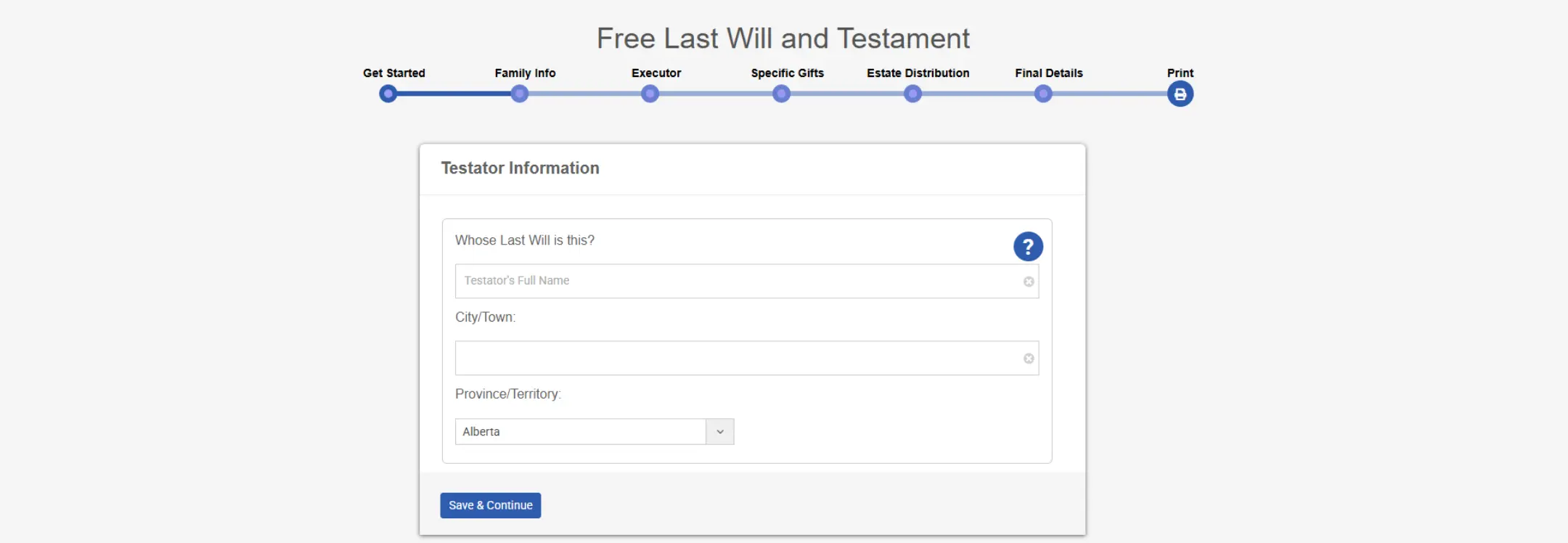
2. Answer Guided Questions
Complete a series of intuitive questions that help you identify your executor, name your beneficiaries, and appoint guardians for any minor children.
3. Preview and Print
Review your customized document for accuracy before printing it and following the provided instructions for signing and witnessing to make it legally binding.
Last Will and Testament FAQs
What is a Last Will?
A Last Will and Testament is a crucial legal document that empowers individuals to express their wishes regarding the distribution of their assets after death. Essentially, it serves as a comprehensive set of instructions, guiding an appointed executor through the process of executing the testator's desires after the testator’s passing.
This may sound complex but our customizable Last Will templates at Ziji Legal Forms will enable you to create a valid and comprehensive Last Will that covers various essential aspects:
-
Appointment of Executor: The testator can designate a trustworthy individual responsible for executing the instructions outlined in the Last Will.
-
Distribution of Assets: Specifies how the testator's estate and assets will be divided among beneficiaries, including specific bequests or inheritances.
-
Appointment of Guardianship of Minor Children: Allows the testator to designate a guardian to care for and protect minor children in the event of their death.
-
Appointment of Caretaker of Pets: Permits the testator to assign someone responsible for the care of their pets after they pass away.
-
Debts and Taxes: Addresses the payment of outstanding debts, taxes, and funeral expenses before distributing assets to beneficiaries.
-
Last Requests: Allows the testator to outline final instructions regarding funeral preferences or the forgiveness of debts owed to them.
Why having a Last Will so important?
Having a Last Will is crucial for individuals who want control over the distribution of their assets after death. Any adult of sound mind can and should create a Last Will to dictate how their estate is to be handled after death. When some dies without a valid will, also know as dying intestate, laws of your jurisdiction would dictate asset distribution, potentially leading to unintended consequences. A Last Will ensures that assets are distributed according to the testator's wishes, preventing confusion or disputes among surviving family members.
Is a Last Will Different from a Living Will?
Yes, a Last Will focuses on asset distribution after death, while a Living Will addresses health care preferences when the individual is incapacitated. A Living Will guides family members on medical treatments the individual would accept if unable to provide consent, such as CPR, blood transfusions, or decisions related to starting and ending life support.
Key Terminology in a Last Will:
-
Testator: The individual writing the will. Sometimes a testatrix is used to refer to a female testator but a testator is the commonly used term to refer to both female and male testators.
-
Executor: The person responsible for executing the testator's wishes as appointed in the Last Will.
-
Guardian: A person designated to care for minor children in case of the testator's death.
-
Executor Bond: A bond that ensures beneficiaries are reimbursed if the executor mishandles assets.
-
Trustee: Manages and administers trust assets for minor children until they reach adulthood.
-
Specific Gift: A designated, specific property bequeathed to a beneficiary in the will. Please note that assets that already have a designated beneficiary cannot be given in a Last Will. Examples of this are pension fund proceeds, life insurance policy, annuities etc.
-
Wipeout Clause: Redirects assets to a specified beneficiary if named beneficiaries and heirs die before the testator. This can also be referred to as a total failure clause, total wipe out clause, common tragedy clause, catch all clause, fail safe clause etc., in a Last Will.
Can pets be mentioned in a Last Will?
A Last Will can be used to ensure the well-being of pets by designating a caretaker and allocating a portion of the estate for their care, covering food, grooming, and medical needs.
Do I need to notarize my Last Will and what about witness requirements?
In most jurisdictions, notarization isn't required, but two witnesses are essential. Witnesses must be of sound mind, at least 18 years old, and not beneficiaries in the Last Will. Their presence during the testator's signing of the document ensures its validity. While not mandatory, notarization can expedite the probate process in the courts.
What is probate?
Probate is the legal process overseen by the court where your Will is validated and executed after your death.
What is an affidavit and why is it often signed with the Will?
An affidavit, also known as an affidavit of execution, is a sworn statement confirming that the signing and witnessing of the Will comply with local laws. By signing and notarizing this affidavit, the Will becomes "self-proved" in probate, meaning its validity is typically accepted without further proof unless contested with credible evidence.
Why is it wise to sign an affidavit with the Will?
If the affidavit isn't signed, witnesses may need to appear in probate court to confirm their roles and the signing process. While not mandatory for a valid Will, signing the affidavit saves time and costs during probate. It also spares the executor from tracking down witnesses later.
Where should you store your Will?
Keep your signed Will and Affidavit in a secure place. Avoid using a safety deposit box as your sole storage, as accessing it requires going through probate, where the Will is needed. Store these documents securely yet accessibly for your executor, and inform them of their location.
How frequently should I revise my Last Will?
It is advisable to review and update your Last Will periodically, such as every few years, or whenever you experience a significant life event like marriage, divorce, the birth of a child, or acquiring significant assets. This ensures that your Will stays accurate and aligns with your current intentions.
Is an online Last Will legally binding?
Yes, an online Last Will can be legally binding if it meets your jurisdiction's legal requirements, including proper signing and witnessing. At Ziji Legal Forms, our templates are crafted by our legal experts to comply with legal standards, ensuring the validity of your Will.
Can I appoint alternate executors in my Will?
Yes. You can designate one or more alternate executors to take over if your primary executor is unable or unwilling to act. This ensures your estate is administered smoothly without delays and provides backup options in case of unforeseen circumstances.
Can I leave provisions for stepchildren or children from a blended family?
Absolutely. You can include stepchildren, adopted children, or other non-biological children as beneficiaries in your Will. Be sure to clearly identify each child and specify what they are to receive to avoid confusion or disputes.
Can I include my digital assets in my Will?
Yes. Digital assets, including online accounts, social media profiles, cryptocurrency, digital photos, or cloud files, can be addressed in your Will. Clearly outline instructions for access, management, or distribution to ensure your wishes are honored.
Can I make charitable donations in my Will?
Yes. You can leave gifts or a portion of your estate to registered charities, nonprofits, or organizations that are meaningful to you. Include the charity’s full legal name and the intended amount or asset to ensure your philanthropic wishes are followed.
What happens if I die without a Will in Canada?
If you pass away intestate—without a valid Will—provincial or territorial laws will determine how your estate is distributed. This may not reflect your personal wishes and could lead to disputes among family members. In some cases, if no legal heirs exist, assets may ultimately revert to the Crown.
What jurisdictions can use our Last Will?
You can use our template to create a legal and valid Last Will for the following jurisdictions:
|
Alberta
British Columbia
Manitoba
New Brunswick
Newfoundland and Labrador
Northwest Territories
Nova Scotia
Nunavat
Prince Edward Island
Saskatchewan
Yukon |
AB
BC
MB
NB
NL
NT
NS
NU
PE
SK
YT |





 Canada
 United States